
A hearing check for your clinic's website
Visitors take it on their own phone, in the browser. No app, no sign-up. A few minutes later they have one result in plain words. When a full hearing test is worth it, the result says so and points them to your clinic.
In the demo, “Your Clinic” stands in for your clinic's name, and the call and booking buttons show a note instead.
Questions first, then the listening check.
About 3 minutes on the phone speaker, or about 8 with earbuds.
- 01Warning signs
Questions about a sudden drop in hearing, fluid from an ear, dizziness and a few other signs. They are asked before anything else.
Urgent answers are dealt with before any sound plays - 02Everyday listening
Everyday listening, from phone calls to busy restaurants. Then a few questions about ringing in the ears.
An answer can move the result toward a full test, never away from one - 03Numbers in noise
Three spoken numbers play over a steady hiss, and the visitor types what they heard. A right answer makes the next round a little harder and a miss makes it easier, for 24 rounds.
Phone speaker or earbuds - 04With earbuds
First a quick check that the earbuds are in, each on its own side. Then an earbud version of the numbers check, and a beep check that compares the left ear with the right.
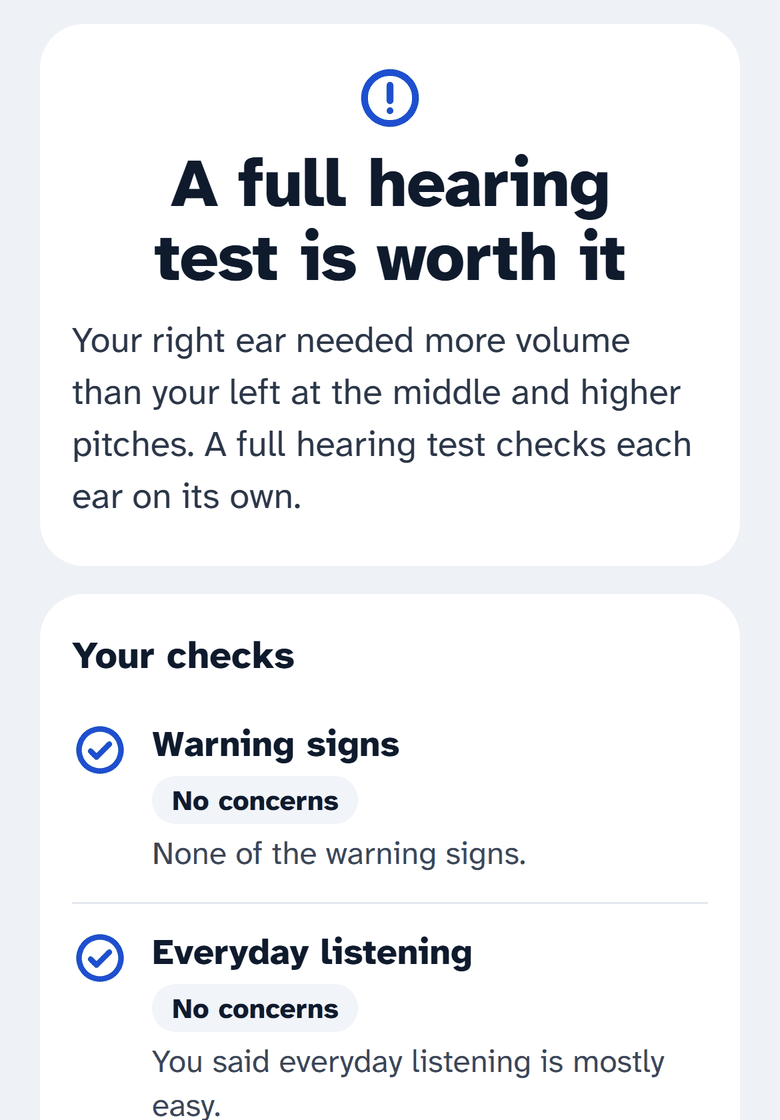
An ear balance graph on the result - 05One result
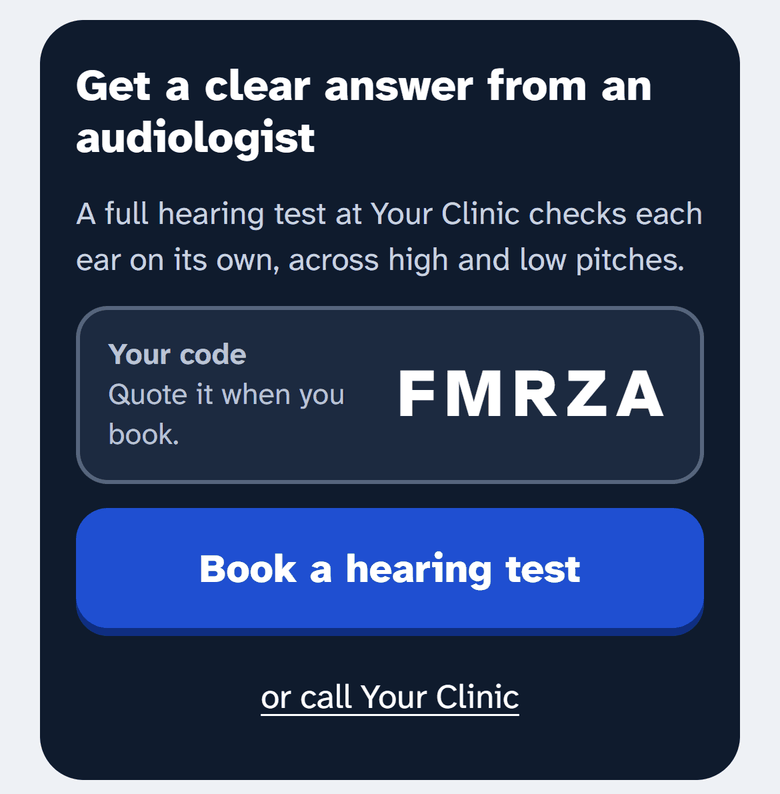
Plain words, at one of five levels from “In the normal range” to “See a doctor today”. A five-letter code to quote when booking, and a PDF to save or bring along.
Booking with your clinic, when a full test is worth it
A screening, not a diagnosis.
The check tells a visitor whether a full hearing test with an audiologist is worth it. It does not say how much hearing loss there is, or what kind. Only that full test can, and the result page says so.
Someone who has been putting off a visit can take it at home, at any hour, and be on your booking page a few minutes later.
Warning signs come before any sound.
Some answers matter more than any listening score, so the check asks about them first. A sudden drop in hearing within the last month brings up “See a doctor today”. The visitor can still finish the check, and the result says it again.
After a sudden drop, the check also asks about signs of a stroke. A yes brings up a single screen: “Call 911 now”. It has no Continue button.
Ringing in the ears gets its own questions. One asks whether the ringing has left the visitor feeling hopeless, or thinking about harming themselves. A yes brings up 9-8-8, the Suicide Crisis Helpline, to call or text at any hour, before the check carries on.
Set up under your clinic's name.
The method behind the listening check.
The listening part is a digits-in-noise test. It is the method the WHO chose for its hearWHO app. Digits-in-noise testing began with the Dutch national hearing test by telephone, and a 2022 review of phone hearing screeners found it the most studied of them.
The numbers and the hiss follow the recipe of the English test in a 2025 study by Polspoel and colleagues in Scientific Reports. The voice was generated by AI.
Read the 2025 studyPolspoel and colleagues, Scientific ReportsIt can miss early changes, especially in the higher pitches. On the phone speaker it can also miss a change in one ear only. The beep check compares one ear with the other, so a change that is the same in both ears does not show there.
Common questions
Ask about a hearing check for your clinic.
Send your clinic's name and how patients book today, or call to talk it through.
Tell us how patients book today, and which checks you would want, if you know.